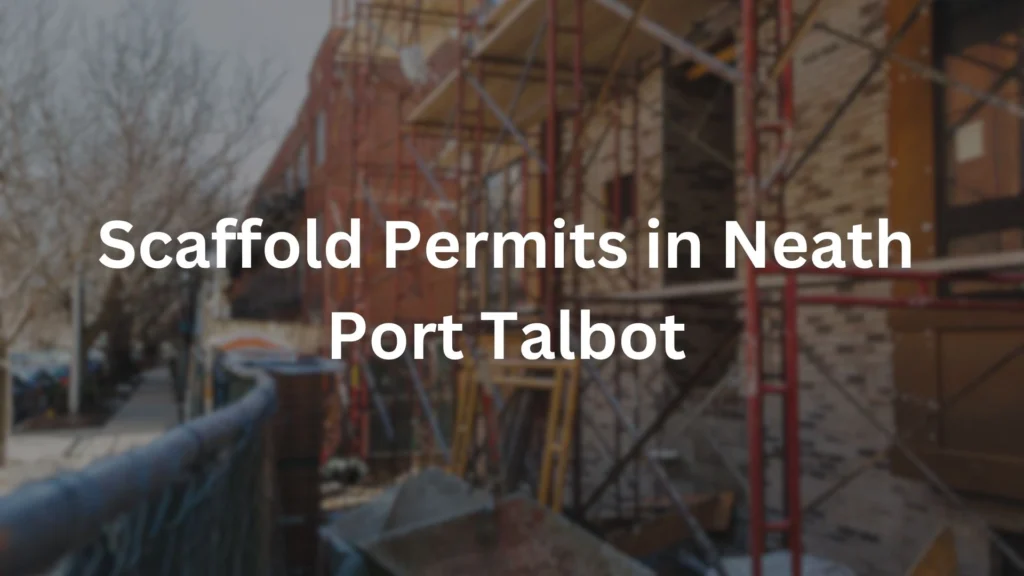
To get a scaffold permit in Neath Port Talbot, the scaffolding company completes the council’s application form, saves it as a PDF, uploads it with proof of public liability insurance of at least £5 million and pays the application fee, which is currently £103.50. A permit is only needed when the scaffold stands on the public highway, such as a pavement, path or road. It is not needed when the scaffold sits entirely on private land.
That is the quick answer. The rest of this guide explains when a permit is required, who has to apply, what the council expects, how extensions work and what happens if a scaffold goes up without one. LMT Scaffolding has supplied safe scaffold access across Neath Port Talbot, Swansea, Bridgend and Cardiff for 10 years, so we deal with this process regularly.
Do You Need a Scaffold Permit in Neath Port Talbot?
Neath Port Talbot Council is the highway authority for the borough. Under Section 169 of the Highways Act 1980, scaffolding cannot be erected on or over a highway in connection with building work unless the highway authority has granted permission in writing. The council sets out its own process on the scaffold permit page of its website.
The question to ask is simple: will any part of the scaffold sit on the pavement, path or road, or overhang it?
| Situation | Permit needed? |
|---|---|
| Scaffold on the public pavement outside a terraced house | Yes |
| Scaffold that extends into the road | Yes |
| Scaffold overhanging a public footway | Yes |
| Scaffold entirely within your front garden or driveway | Usually no |
| Scaffold at the back of the property on private land | Usually no |
Across Neath Port Talbot you will find plenty of terraced streets, particularly in the valleys and town centres, where the front of a house opens directly onto the pavement. For those homes, a front elevation scaffold almost always lands on the highway, which means a permit is required.
If you are unsure, a site visit from your scaffolder will settle it quickly.
Who Applies for a Scaffold Permit in Neath Port Talbot?
The scaffolding company applies, not the homeowner. The council’s terms and conditions state that it is the responsibility of the company providing the scaffolding to contact the council and request permission to place it on the highway.
That fits with the council’s requirement that anyone applying must provide proof of public liability insurance. The insurance must be a minimum of £5 million, and the council keeps a copy of the current certificate on file. The application form also confirms that the company will indemnify the council against claims arising from the scaffold.
In practice, this means you should do two things before you book:
- Ask the scaffolder whether a permit will be needed for your job
- Ask who is applying for it and how the cost is shown in the quote
At LMT Scaffolding we carry public liability insurance and are CISRS qualified and NASC members. On many jobs we handle the permit application ourselves, and we confirm at the quote stage who is applying so there is never any confusion about who is responsible.
How to Get a Scaffold Permit in Neath Port Talbot, Step by Step
Here is how the process works from start to finish.
Step 1: Get a site visit and written quote
Your scaffolder looks at the property, checks whether the scaffold will stand on the highway and works out the size and layout. You receive a written quote. At LMT Scaffolding the quote is free and carries no obligation.
Step 2: Confirm who applies
Agree with your scaffolder whether they will make the application. Make sure the quote shows how the permit fee is handled.
Step 3: Complete the council’s application form
The scaffolding company fills in the council’s application form. It asks for:
- Company name, address, telephone number and email
- The address where the scaffold will stand
- The position of the scaffold
- The dates the scaffold is needed, with the form covering a 28 day period
- A signature and date
Step 4: Save as a PDF and apply online
The council asks applicants to complete the form, save it as a PDF and upload it during the online application process.
Step 5: Provide proof of insurance
Alongside the form, the applicant must provide proof of public liability insurance of at least £5 million.
Step 6: Pay the fee
The fee for applying for a scaffold permit is currently £103.50. Fees can change, so check with the council or ask your scaffolder to confirm the current figure.
Step 7: Agree timings and follow the conditions
The council’s terms say that the times of erecting the scaffold must be agreed in advance. Once the permit is granted, the scaffold must be built and used within its conditions.
What Does a Neath Port Talbot Scaffold Permit Cost?
| Item | Detail |
|---|---|
| Application fee | £103.50 at the time of writing |
| Insurance | Proof of public liability cover of at least £5 million required |
| Permit period | Application form covers a 28 day period |
| Further periods | Re-apply, giving 48 hours notice |
The permit fee is separate from the cost of the scaffold itself. A good scaffolder shows any permit cost clearly in the written quote so there are no surprises on the final bill. For a broader view of pricing, see our guide on how much scaffolding costs in Cardiff, which explains what drives scaffold prices across South Wales.
What Conditions Come With a Permit?
A permit is not just permission. It is permission with rules. The council says conditions may relate to:
- The location of the scaffold
- The available space on the footway
- Pedestrian access
Additional conditions can apply to individual applications. The terms and conditions also set out several duties for the company that holds the permit:
- The scaffold must not be erected without a permit
- The scaffold must not be left on the highway unlicensed
- The council must be told when the scaffold is removed
- The scaffold must be moved or repositioned if the police, the council or statutory undertakers need access to their apparatus
- The council can revoke the permit at any time if conditions are not met, and the scaffold must then be removed straight away
- Any scaffold the council considers dangerous can be removed and stored, with the licensee informed and charged
Keeping pedestrians moving safely is a major part of this. On narrow valley streets, the way a scaffold is laid out around the footway matters as much as the scaffold itself, and a well planned job keeps the pavement usable for neighbours and passers by.
How Do You Extend a Scaffold Permit?
Many jobs run longer than first planned. Weather, material deliveries and extra work can all stretch a project. If you need the scaffold for a further period, the council says you must re-apply and give 48 hours notice.
That is a short window, so the practical advice is simple:
- Check the end date on the permit as soon as it is issued
- Keep in touch with your builder or roofer about progress
- Flag any likely overrun to your scaffolder early
- Ask your scaffolder to re-apply well before the permit expires
A scaffold left on the highway after its permit has expired is unlicensed, which puts the scaffolder, and your project, at risk.
Case Study: Extending a Permit on a Longer Job
A homeowner in Neath Port Talbot had building work on a terraced property where the scaffold stood on the pavement. The permit covered the period originally planned, but the job overran. Roofing was delayed and the work needed more days than expected.
The danger was easy to spot. The permit end date was approaching, and if the scaffold had stayed up after it expired, it would have been unlicensed.
What we did
- We checked the permit end date against the revised programme as soon as the delay became clear
- We re-applied for a further period with the notice the council requires
- We kept the scaffold inspected and in good order throughout the extra time
- We told the council when the scaffold was finally taken down
The result
The scaffold stayed licensed for the full duration of the job, the builder was not held up and the homeowner avoided any problems with the council.
The lesson
A permit is only valid for the dates it covers. Jobs overrun, so a reliable scaffolder watches the end date and acts early. When you compare quotes, ask what happens if the project takes longer than planned.
What Happens If You Scaffold Without a Permit?
Putting scaffolding on the highway without permission breaks the Highways Act. In Neath Port Talbot the council’s terms say a scaffold must not be erected without a licence and must not be left on the highway unlicensed. The council can revoke a permit, and it can remove and store any scaffold it considers dangerous and then charge the licensee.
For a homeowner, the wider risks are practical:
- Your builder or roofer may have to stop work while the scaffold is removed or relicensed
- The project programme slips, which can add cost
- An unlicensed, uninsured scaffolder may leave you exposed if something goes wrong
The safest approach is to hire a scaffolder who confirms the permit is in place before anything goes up.
How to Choose a Scaffolder Who Handles Permits Properly
Use this checklist when you phone around:
- Will the scaffold stand on the highway, and is a permit needed?
- Who is applying for the permit, and how is the cost shown in the quote?
- Can I see your public liability insurance certificate?
- Can I see your CISRS cards or NASC membership?
- Will the scaffold be built to TG20:21?
- What happens if the job overruns and the permit needs extending?
- Will the scaffold be inspected and tagged before anyone uses it?
A reliable firm answers all of these without hesitation. Our guide on how to find a reliable scaffolder in South Wales covers these checks in more detail, and our guide on getting a scaffolding licence in Cardiff explains how the equivalent process works across the border in the capital.
Why Use a Local Neath Port Talbot Scaffolder?
A local scaffolder understands the area, from terraced streets in the valleys to homes in the towns along the coast. We know how to plan around narrow pavements, steep streets and tight access, and we know the council process well enough to keep your job on schedule.
LMT Scaffolding serves Neath Port Talbot, Swansea, Bridgend and Cardiff. We turn up on time, communicate clearly and give a free, no obligation quote before any work begins.
Frequently Asked Questions
Do I need a scaffold permit in Neath Port Talbot?
You need one if any part of the scaffold stands on or over the public highway, which includes the pavement, a path or the road. If the scaffold sits entirely on private land, a permit is usually not required.
Who applies for a scaffold permit in Neath Port Talbot?
The scaffolding company applies. The council’s terms say it is the company’s responsibility to contact the council and request permission to place scaffolding on the highway.
How much does a scaffold permit cost in Neath Port Talbot?
The application fee is currently £103.50. Fees can change, so confirm the current figure with the council or your scaffolder.
What insurance is needed for a scaffold permit?
Applicants must provide proof of public liability insurance with a minimum of £5 million of cover. The council keeps a copy of the current certificate on file.
How do I extend a scaffold permit in Neath Port Talbot?
You need to re-apply for the further period, giving 48 hours notice. Ask your scaffolder to monitor the end date and apply early if the job is running late.
What conditions apply to a scaffold permit?
Conditions can relate to the location of the scaffold, the space available on the footway and pedestrian access. Additional conditions may apply to individual applications.
Can the council remove my scaffold?
Yes. The council can revoke a permit if conditions are not met, and it can remove and store any scaffold it considers dangerous. The licensee is informed and charged.
What should I do when the scaffold comes down?
The scaffolding company must inform the council when the scaffold is removed. Your scaffolder should handle this.
Do I need a permit for scaffolding at the back of my house?
Usually not, as long as the scaffold stays on private land and does not obstruct a public highway. Your scaffolder will confirm this during the site visit.
Does LMT Scaffolding arrange permits?
On many jobs, yes. We confirm at the quote stage who is applying, so you know exactly who is responsible before work starts.
Final Thoughts
Getting a scaffold permit in Neath Port Talbot is simple when the right firm is in charge. The permit is needed whenever the scaffold touches the pavement or road, it is applied for by the scaffolding company with proof of at least £5 million public liability cover and the fee is currently £103.50. Watch the end date, extend early if the job overruns and avoid unlicensed scaffolding at all costs.
If you are planning work in Swansea, Neath Port Talbot, Bridgend, Cardiff or the Vale of Glamorgan, our domestic scaffolding team can help. Contact LMT Scaffolding for a free, no obligation quote.